

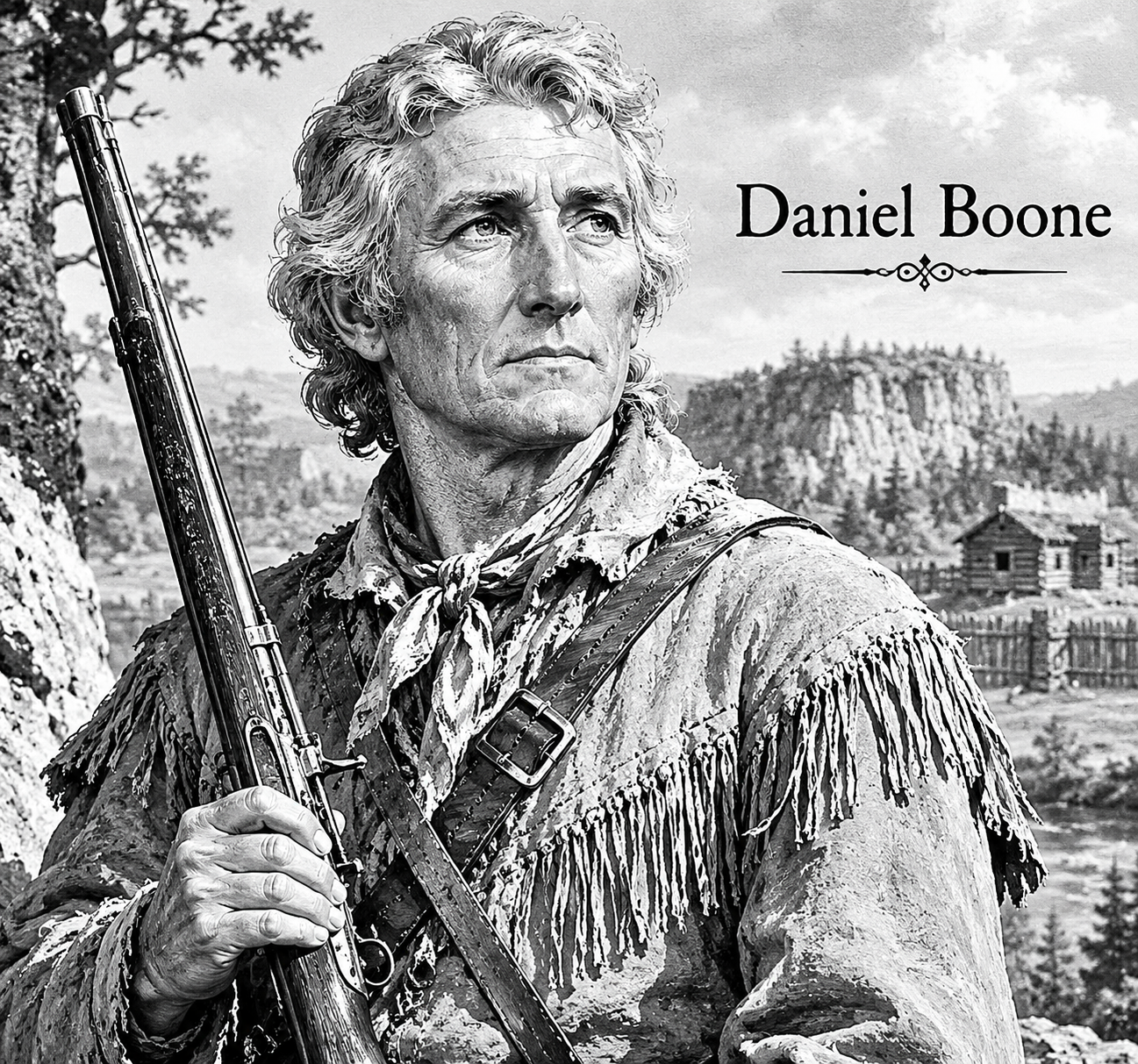
Part 1: From Pennsylvania to the Wilderness — The Making of Daniel Boone
Daniel Boone is often remembered as a larger-than-life frontiersman, but his story starts in a far simpler setting: a rural community in colonial Pennsylvania. Boone was born on November 2, 1734, in a Quaker household where hard work, independence, and a love of nature were prized. [1]
Get an overview of Daniel Boone: Daniel Boone overview
Boone had little formal education in comparison to many of his contemporaries. And the wilderness was his classroom. From a young age, he learned to hunt, track, and survive—skills that would later determine his reputation. [2]
Biography details: Daniel Boone early life
Life on the Edge of the Frontier
Boone’s family moved to the Yadkin River valley in North Carolina in 1751, a rugged area on the edge of colonial settlement.
Living on the frontier required resilience. Settlers lived alone, in harsh environments, and in the shadow of uncertainty. Boone enjoyed it; he became so good at this world. He became a veteran of living off the land and traveling through dense forests and in foreign environments.
But this environment did not just shape his skills—it shaped his identity. Boone was not just surviving in the wilderness; he was becoming part of it.
More context: Frontier life and Boone’s background
Early Experiences That Shaped Him
As a young man, Boone did work that honed his frontier skills. He was a wagoner in the French and Indian War, delivering supplies across dangerous terrain. [3]
This role gave him experience navigating unfamiliar terrain and exposed him to the dangers of frontier conflict. It also laid the groundwork for him to become a guide and trailblazer later.
Boone married Rebecca Bryan in 1756, and they established a family life on the frontier
More about his life: Daniel Boone biography summary
Boone's love of exploration, even with family responsibilities, continued to grow.
The Call of the West
One of Boone’s life turning points was when he met a hunter named John Finley. Finley told stories about Kentucky—a land brimming with game and opportunity.
At the time, Kentucky was mostly unknown to settlers from the Eastern colonies. Boone was so attracted to the idea of exploring such territory.
What these stories did for him was to create a vision of life beyond the settled frontier. What began as curiosity turned into a burning desire.
Learn more: Daniel Boone’s exploration background
A Legend in the Making
By adulthood, Boone had developed the very qualities that would define his legacy:
- Expert hunting and survival skills
- Experience traveling dangerous and unfamiliar terrain
- A deep motivation to explore westward
These traits set him apart from most settlers of his time. They prepared him for the future travels that he would go on and would soon make him famous.
At this stage, Daniel Boone was not yet a legend. He was merely a man shaped by his environment—one who was about to follow his instincts into the unknown frontier
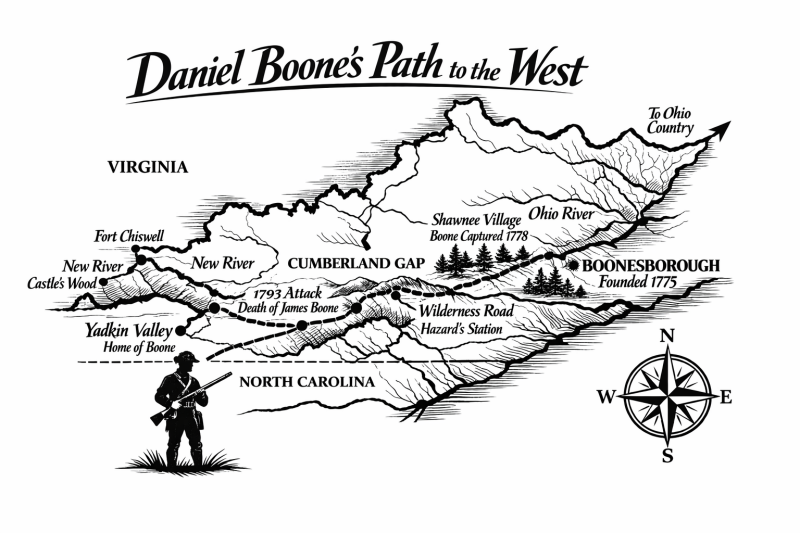
Part 2: Blazing the Wilderness Road — Daniel Boone and the Opening of Kentucky
Daniel Boone’s early life prepared him for the frontier—but it was his exploration of Kentucky that transformed him from a skilled woodsman into a historical icon.
By the late 1760s, Boone was ready to act on the curiosity he had in his youth. Just as the stories he had heard about Kentucky were no longer just stories—they became a destination.
Into the Unknown: Boone’s First Journey to Kentucky
In 1769, Daniel Boone and a few friends went through the Cumberland Gap, a natural passage of the Appalachian Mountains.
They were simple—they wanted to travel to the very far reaches that were not occupied by the established colonies.
At that time Kentucky was not a desert. Native American groups had used it for hunting and travel for decades.
Boone and his crew spent months exploring, hunting, and mapping the area. And although the land was a dangerous place—they were captured by Native Americans and the supplies were not enough—they learned many things they needed, and they knew it.
Learn more about his explorations:
Daniel Boone - Britannica Overview
The Wilderness Road: Opening a Path West
Boone’s greatest contribution came in 1775, when he established what would become the Wilderness Road. [4]
Boone and a team of about 30 men were hired by the Transylvania Company to cut a trail through thick forests and rugged mountains from Virginia into Kentucky. [5]
This was not a small feat. As difficult as it was to navigate the terrain, the weather was bad and the problem of Native Americans not wanting to settle on their land was still there.
Even with this difficulty, the Wilderness Road was one of the most important migration routes in early American history. By the end of the 1700s, thousands of settlers had followed Boone’s path.
Explore the significance of the trail:
Boonesborough: A Frontier Settlement
Boonesborough was founded in 1775, one of the first permanent English-speaking settlements west of the Appalachian Mountains.
Boonesborough quickly became a critical base for westward expansion. It provided a base for settlers as they moved into the area and a defense in a dangerous frontier.
Life in Boonesborough was challenging. Settlers were forced to build homes, grow food, and protect themselves—all while adapting to a new and unfamiliar landscape.
Boone’s leadership was instrumental in the settlement’s survival in the early years.
Learn more about Boonesborough:
Changing the Course of American Expansion
Boone’s work in Kentucky changed the future of the United States.
Before Wilderness Road, there was little movement westward. After it, thousands of settlers came to Kentucky in a major wave of migration that would last for decades.
It’s important to note, however, that Boone did not “discover” Kentucky. The land had long been known and used by Native American tribes.
What Boone did was different—he made the region more accessible to settlers, helping accelerate expansion into the western frontier.
A New Reputation
By the mid-1770s, Daniel Boone was no longer just a skilled woodsman.
He had become:
- A trailblazer who opened new pathways west
- A founder of one of the earliest frontier settlements
His reputation began to spread, setting the stage for the legend he would later become.
Add comment
Comments