

Part 4 : Outrage and Reform: The Fight to End Child Labor
The Story Spreads
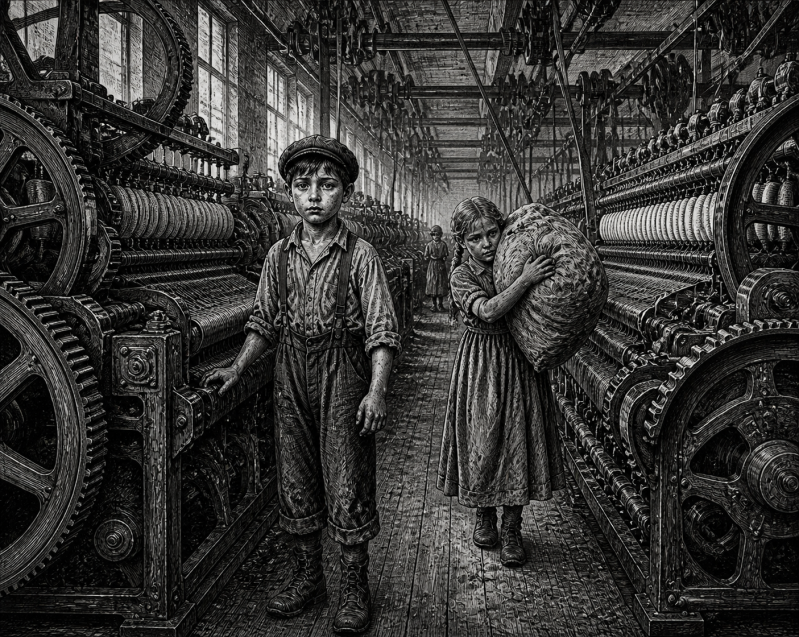
At first, the suffering stayed inside the factories.
Children worked behind brick walls and iron machines unseen. Their long hours, their injuries, their exhaustion those were only known to families, overseers, and the children themselves.
But slowly that began to change.
Whispers became testimony. Testimony became reports. Reports became an outrage.
And once the public began to see it, it could not easily look away.
The Voices Break Through
“I began to work when I was six years old…”
The words were simple. The impact was not.
In 1832, the British Parliament formed the Sadler Committee to gather witness testimony from workers—many of whom were children or former child laborers. What they heard shocked the nation.
“From five in the morning to nine at night.” [everycrsreport.com]
“If I had been too late, I was most often beaten.” [everycrsreport.com]
These were not isolated accounts. They were repeated, consistent, and undeniable.
The report presented a grim picture: children working long hours, suffering punishment for it, and enduring conditions that even adults could not survive.
Historians said the investigation was a “formidable indictment” of factory life and revealed widespread human misery and abuse. [stopchildlabor.org]
This was the first time many of the readers had ever really understood what industrial progress had cost.
Seeing What Words Could Not Show
Images stirred outrage when words could not—but images were impossible to ignore.
A few decades later, in the United States, a photographer named Lewis Hine went on that mission. He traveled from state to state, documenting children at work—in factories, mines, mills, and fields.
His images did something revolutionary: they showed childhood and labor colliding in a single frame.
“The object of employing children is not to train them, but to get high profits from their work.” [bls.gov]
In one picture, a young girl stands at a spinning machine—barely tall enough to reach it. In another, boys covered in coal dust stare out from the darkness of a mine.
They were not statistics.
They were children.
And once the public was able to see them, indifference became harder to justify.
Hine’s work and similar efforts helped expose how widespread and damaging child labor had become, contributing to a broader push for reform. [theirworld.org]
The First Attempts at Changing Child Labor Laws
Reform did not come quickly—or easily.
Even as public outrage grew, early laws were cautious and limited.
The first legislation did not aim to end child labor entirely. Instead, it tried to make it slightly less harmful:
- Limit working hours
- Set minimum ages for certain jobs
- Improve basic working conditions
But enforcement was weak.
Factories often ignored the rules. Inspections were rare. And families still depended on the wages children brought home.
The system bent—but it did not yet break.
A Turning Point: Government Steps In
But something fundamental had changed: governments could no longer ignore the issue.
In Britain, the Factory Act of 1833 marked a turning point:
- It restricted the number of hours children could work
- It prohibited the employment of very young children
- It introduced inspectors to enforce the law
The act did not end child labor—but it acknowledged, for the first time, that it needed to be controlled.
This moment was significant not just for its rules, but for what it represented:
The beginning of state is responsible for protecting children.
Why child labor laws Reform Took So Long
If conditions were so severe, why didn’t change happen sooner?
The answer lies in competing realities:
- Economic Dependence
Families needed the income. Without it, survival was uncertain.
- Industrial Resistance
Factory owners relied on cheap labor and resisted regulation.
- Cultural Acceptance
For generations, child work had been normal. The idea that it could be harmful took time to take hold.
- Limited Enforcement
Even when laws were passed, enforcing them proved difficult.
Reform was not a single event—it was a long, contested process.
From Sympathy to Action
By the late 19th and early 20th centuries, momentum began to be built.
Journalists, activists, religious leaders, and labor organizers all joined the cause. They argued not just for better conditions—but for a new idea:
that children deserved a childhood.
Organizations are formed. Campaigns spread. Public awareness has grown.
And slowly, the balance began to shift—from acceptance to resistance, from resistance to reform.
Closing Thought
The fight against child labor did not begin with laws.
It began with awareness—with stories, testimonies, and images that revealed what had been hidden.
Outrage came first. Reform followed.
But even as laws emerged, the system they tried to change was deeply rooted—and far from gone.
Part 5 — Laws That Changed Childhood
Series: Child Labor Through the Ages: From Survival to Reform.
When Outrage Became Law
By the early 19th century, the problem was no longer hidden.
Reformers' speakers were testified. Photographers had shown the world what industrial childhood looked like.
But outrage alone could not change the system.
Factories still need workers. Families still needed wages. And the children were still going to work.
If childhood was to be reclaimed, it would not happen through sentiment—it would happen through policy.
With this in mind,
The First Wave: Early Factory Laws (1802–1847)
The early reforms were tentative and often ineffective, but they were a significant change: governments were beginning to intervene.
Key Laws (United Kingdom)
1802 - Health and Morals of Apprentices Act. Limited workdays to 12 hours. Some basic education is required. [[britannica.com]] Unenforced.
1819 Factory Act. The employment of children under 9 was prohibited. Older children had restricted hours.
1833 Factory Act. • Factory work for children under 9 years old was banned.
- Children (9-13) were limited to working only for 48 hours (about 4 days) a week. • Factory inspectors were introduced for enforcement Tooting 180
1844 - Factory Act. Reduced working hours further. Introduced safety regulations for machinery 1844 Factory Act
- 1847 - Ten-hour law. Limited workday for women and children to 10 hours.
What Changed?
For the first time, governments acknowledged something radical:
Work was no longer just a private matter between employer and family—it was a public issue.
These laws:
- Defined limits on child labor.
- Started enforcing workplace safety.
- Introduced the notion that children needed protection.
But they did not eliminate child labor.
They regulated it.
The American Struggle: Failed Attempts and Breakthroughs
Across the Atlantic, reform was even slower.
In the United States, child labor remained widespread well into the early 20th century. Millions of children worked in factories, mines, and fields.
Timeline of U.S. Policy Efforts
- 1830s-1890s. * State-level laws are tried to limit hours and require schooling. • Enforcement was inconsistent and often weak Stop Child Labor .
- 1904 - National Child Labor Committee created. Led national campaigns for reform. Used photography and advocacy to build public support
- 1916– Keating-Owen Act. First federal attempt to regulate child labor.
- Restricted interstate sale of goods produced by children. Struck down by the Supreme Court in Keating Owen Act (1916)
- 1920s - Constitutional Amendment attempt. Aimed to give Congress power to regulate child labor. Not enough support.Regulating Child Labor
The Turning Point: 1938
The system was reformed after decades of failed reforms, and one law changed the system:
Fair Child Labor Standards Act (FLSA), 1938
- Set minimum working ages.
- Restricted working hours for minors.
- Prohibited employment of children in hazardous jobs.
- Established nationwide federal enforcement U.S, Department Of Labor
The law defined “oppressive child labor” and banned it in most industries.
For the first time in U.S. history, child labor was not only discouraged, but it was systematically controlled at the national level.
The Quiet Revolution: Compulsory Education
While laws restricted work, another force helped to eliminate it:
School.
In the late 19th and early 20th centuries, governments began to require children to go to school.
- Education laws made work less possible.
- Minimum age laws linked employment to schooling.
- Public education gradually replaced child labor.
“Compulsory education… is a critical preventive measure” in eliminating child labor.
Such a change was trans formative.
Instead of asking:
- How many hours should children work?
Society began asking:
- Should children be working at all?
The Global Stage: International Standards
By the late 20th century, child labor had become a global issue, not just a national one.
Organizations like the International Labor Organization (ILO) established international standards:
Key Conventions
- 1973 – ILO Convention 138. Set minimum working age. Required countries to develop policies to eliminate child labor. ILO Convention
- 1999 - ILO Convention 182. Targeted the “worst forms” of child labor (slavery, trafficking, hazardous work). Required immediate elimination .199-ILO Convention 182
These conventions set up a global framework that is pushing countries to strengthen child protection laws and protections.
What Policy Actually Achieved
By the mid-20th century in industrialized countries, child labor had rapidly declined.
Not because of one law—but because of a system of reforms:
- Labor laws restrict employment.
- Compulsory education laws keeping children in school.
- Public awareness and enforcement mechanisms.
Together they altered childhood itself.
Limits of Reform
Even the most successful policies had limitations:
- Child labor continued in agriculture and informal sectors.
- Enforcement varies widely.
- Economic pressures still pushed children to work.
And globally, the problem was far from solved.
But the direction had changed.
For the first time in history, the dominant goal was no longer managing child labor—it was ending it.
Closing Thought
Childhood was not restored overnight.
The result was a new idea; one we now take for granted:
Those children belong to school, not in factories.
And as we will see in Part 6, this idea is still not universal.
Part 6: Child Labor Today: A Global Reality
From survival to reform: Child Labor Through the Ages.
The Story Isn’t Over
It is tempting to think of child labor as a problem of the past.
After all, in many industrial countries, factory floors once filled with children are now museums, or even historical sites. Laws have passed. Schools replaced workplaces. Childhood, as we understand it today, has largely been restored.
But step out there and away from that narrative—and the reality is very different.
Child labor did not disappear.
It changed locations.
A Global Snapshot
Today child labor remains a significant global problem.
About 138 million children worldwide engage in child labor. More than 54 million works in hazardous conditions that threaten their health and safety.
These are not isolated cases. Still in some regions child labor is still affecting a significant portion of the population.
The largest share of child labor is found in:
Agriculture (around 60%). Services (domestic work, street vending). Industry (mining, manufacturing).
Unlike the factory systems of the Industrial Revolution, today’s child labor is often hidden—spread across rural farms, informal economies, and supply chains that stretch across continents.
Why Child Labor Still Exists
The reasons may sound familiar.
But there is so much that the root causes remain the same after centuries of reform for all of us.
- Poverty
Families rely on children’s income to survive.
In most cases child labor is most often the result of financial hardship or a sudden economic shock to families.
- Lack of Access to Education
The other option is to work when schools are out of reach, unaffordable, or low quality.
- Economic Demand
Global industries—particularly agriculture and manufacturing—still rely on cheap, unregulated labor.
- Conflict and Instability
War, migration, and displacement push children into labor or even trafficking.
- Weak Enforcement
Even where laws exist, they are not always enforced.
Past and Present: What Has Changed?
Today’s child labor may seem very different from the mills and mines of the 19th century at first glance.
But look closer.
Then (Industrial Revolution)
Factories and mines. Long, centralized shifts. Visible exploitation.
Now (Modern Era)
- Farms, streets, and informal economies.
- Fragmented and often hidden work.
- Exploitation embedded in global supply chains.
The structure has changed—but the underlying dynamic has not:
economic necessity meeting economic demand.
The Worst Forms Still Exist
Some of the worst abuses still occur despite international laws and conventions.
The “worst forms” of child labor under modern definition are:
- Forced labor and slavery.
- Human trafficking.
- Child soldiering.
- Hazardous industrial work.
The ILO’s Convention 182 (1999) requires countries to eradicate these practices immediately.
Despite that, they persist—mostly because of the systemic issues of poverty, inequality, and conflict.
The Role of Education Today
Education is in the moment still one of the most significant tools of change.
Where children have access to:
- Free schooling.
- Safe environments.
- Economic support.
Child labor declines.
Where they do not, it persists.
Education is viewed as a “critical preventive measure” in eliminating child labor.
This connection—between school and labor—has been a continuing one for over a century.
Progress—and Its Limits
There is real progress worth recognizing:
- Global child labor has declined significantly since 2000.
- International agreements have produced shared standards.
- Awareness is higher than ever.
But the change is slow.
Some regions have made significant progress. Others remain so severely affected.
And the global crises of recent years—economic instability, pandemics, conflict—have slowed or even halted the progress.
A Connected World
One of the biggest differences today is this:
Child labor is no longer isolated it is global.
Products made or harvested by children can be traded from one country to another and into international markets and supply chains.
This means:
- Consumers are connected to the issue.
- Businesses are increasingly held accountable.
- Governments need to work internationally.
Child labor is no longer just a local problem—it is now a global system.
Final Reflection: What History Teaches Us
Looking back at this series, one lesson is clear:
Child labor has never had a single cause or a single solution.
It has always been shaped by:
- Economics.
- Culture.
- Law.
- Opportunity.
In the 19th century, reform involved a combination of:
- Public awareness.
- Legislation.
- Education.
And today those same forces are still essential.
Closing Thought
The story of child labor is not only about the past about choices.
At every stage in history, societies have had to decide:
- What is acceptable.
- Who is protected.
- And what should childhood look like.
In many parts of the world, that decision is still being made.
Series Conclusion
From farm labor to factory exploitation…
Child labor is not a closed chapter.
It is an ongoing story—one shaped by the same forces that shaped the past.
Below are charities and foundations that are combating this horrific practices
https://endchildlabor.net/
https://www.savethechildren.org/
https://www.worldvision.org/homepage-subscribe
Add comment
Comments