

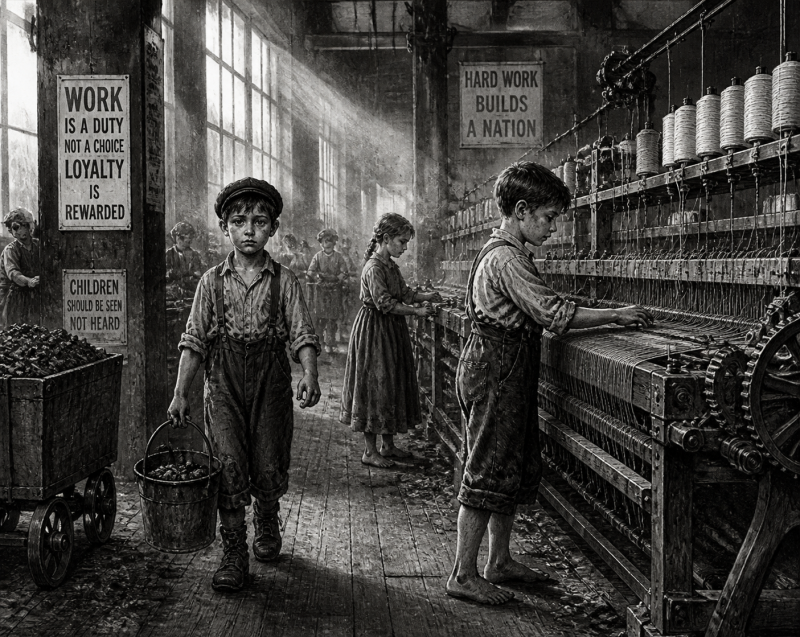
Part 1 — Before Factories: When Child Labor Was Just “Work”
In the series: Child Labor Through the Ages: From Survival to Reform
A World Where Childhood Meant Contribution
Children worked—but not as we imagine today, long before smokestacks darkened city skies or factory whistles marked the passing of time.
Work was woven into daily life in pre-industrial societies. Children weren’t separated from the economic fabric of the household; they were part of it. A child’s work involved tending crops, feeding livestock, helping in family trades, or learning skills that would keep them in the world as adults.
“Children worked on family farms and as indentured servants… To learn a trade, boys often began their apprenticeships between the ages of ten and fourteen.” [history.com]
This wasn’t exploitation in the modern sense. Instead, it was survival—and preparation.
Image: Rural Childhood Work (Illustrative Scene)

Caption: Children in agrarian societies did things like harvesting and tending animals and helped the family economy, rather than working in separate industrial jobs.
Families, Not Factories
Large families were often an advantage in agricultural economies. Every extra pair of hands mattered. Children would plant crops, mend fences, and do household work—all essential for survival.
“At an age as young as 5, a child was expected to help with farm work and other household chores.” [bls.gov]
The distinction between learning, helping, and working was blurred. And at times there was no time to clock; there were no wages, and there was little or no time to have a formal distinction between childhood and adulthood.
Children were not sheltered from labor; they were gradually introduced to it.
Apprenticeship: Work as Education
Not all of their childhood work happened in the field. And for a lot of them, particularly in small towns and small cities, apprenticeship was the way to adulthood.
Young boys and girls were sent to live with master craftsmen. They learned about the trade of blacksmithing, weaving, or carpentry. Those arrangements meant food, shelter, and training instead of wages.
“Children were often apprenticed… learning trades that prepared them for adult economic life.” (Summary based on historical accounts of pre-industrial labor systems; see cited context above)
What we might now consider labor was a form of education in that context.
Not All Work Was Equal
It’s important not to romanticize this time. Life was hard, and children were not spared from their difficulties.
- Work could still be physically demanding.
- Poverty forced many children into early employment.
- Some worked outside the family as servants or laborers.
But the key difference is structure and scale. Child work was:
- Embedded in family life.
- Seasonal rather than continuous.
- Less mechanized and (generally) less hazardous.
There were no sprawling factories that required 12-hour shifts. That transformation had yet to take place.
A Different Idea of Childhood
The concept of childhood itself was different. There was little expectation of prolonged schooling or a protected developmental phase.
Instead, children were seen as:
- Future workers.
- Contributors to family survival.
- Apprentices in training.
And modern ideas of childhood—childhood as a time for education, play, and development—were still emerging.
Primary Source Reflection
Although few direct child testimonies exist from this early period, later historians and observers can summarize the prevailing mindset clearly:
“Children have always worked.” [bls.gov]
This simple statement captures a fundamental truth: what changed history was not whether children worked—but how and where they worked.
The Turning Point Ahead
For centuries, child work was part of life. But starting in the late 18th century, a major change started.
Industrialization would:
- Separate work from home.
- Replace family-based work with wage labor.
- Push children into factories, mines, and mills.
And with that change, the meaning of child labor would change—from necessity into exploitation.
Closing Thought
Before factories, child labor was not yet a social crisis—it was a social norm. But as you’ll see in Part 2, the Industrial Revolution didn’t only change how goods were made. It changed what it meant to be a child.
In Part 1, we saw how children's work was once tied to the rhythms of family life fields, workshops, and apprenticeships. But the Industrial Revolution shattered that structure. Work moved out of the household and into factories. Production became mechanized, centralized, and relentless. Children were no longer learning alongside parents; they were entering a new world of wage labor. And in that world, childhood changed forever.
Part 2 — Factories, Mines, and the Rise of Exploitation
Series: Child Labor Through the Ages: From Survival to Reform
When Work Left the Home
In Part 1, we saw how children's work was once tied to the rhythms of family life fields, workshops, and apprenticeships. But the Industrial Revolution shattered that structure. Work moved out of the household and into factories. Production became mechanized, centralized, and relentless. Children were no longer learning alongside parents they were entering a new world of wage labor. And in that world, childhood changed forever.
Children on Farms Before factories dominated the landscape, most child labor existed in agriculture. Even during the Industrial Revolution, many working children were still found not in cities, but in fields, farms, and rural villages. [worldhistory.org],
For these children, work began early—sometimes as young as five or six—but it looked different from what would come later.
They worked as part of the family economy, not for a distant employer.
Life and Labor in the Fields
Farm work was woven into everyday life. Children worked alongside parents, siblings, and neighbors, contributing to the survival of the household.
Their tasks were varied and constant:
- Planting seeds and pulling weeds
- Harvesting crops by hand
- Feeding and tending animals
- Carrying water, wood, or produce
- Herding livestock across open land
Boys often cared for animals—cattle, sheep, or horses—while girls might milk cows, gather eggs, or tend gardens. [eh.net]
This division of labor reflected both tradition and necessity.
Work Without Clocks
Unlike factory labor, farm work was not measured by the clock but by the seasons.
- During planting and harvest, days stretched from sunrise to sunset
- Urgent work could not wait; crops had to be planted, gathered, or saved from weather
- Children worked hardest when families needed them most
The rhythm of labor followed nature—but the workload could still be intense, repetitive, and physically exhausting.
Not Gentle Just Different
Farm labor is sometimes remembered as softer or more “natural” than factory work. In some ways, it was:
- Children worked with family rather than overseers
- Skills were passed down across generations
- There were often flexibility outside peak seasons
This does not mean it was easy or safe.
Children still faced:
- Heavy physical labor (lifting, digging, carrying)
- Exposure to extreme weather
- Injuries from tools, animals, or exhaustion
- Limited or interrupted access to education
And like factory work later, labor often replaces schooling entirely. A System Built on Necessity
The key difference between farms and factories was the person who depended on the child.
On farms:
- Children worked because families needed them
- Labor ensured food, survival, and stability
- Most farms could not afford hired workers
In factories:
- Children worked because employers benefited from them
This distinction matters.
Farm labor was rooted in family survival. Factory labor would become something else: a system driven by profit and efficiency.
Why Children Became “Ideal Workers”
When industry expanded, child labor didn’t begin it was transformed.
Factories didn’t merely accept children they depended on them.
Industrial employers valued children for three key reasons:
- They were cheap: children often earned only a fraction of adult wages—sometimes as little as 10–20%
- They were small and agile: ideal for crawling into machines or tight spaces
- They were easily controlled: less likely to resist authority
This was a fundamental shift.
Children were no longer contributing to a family economy—they were being absorbed into an industrial system.
Image: Children at Work in Agriculture
https://www.historyplace.com/unitedstates/childlabor/hine-cotton.jpg
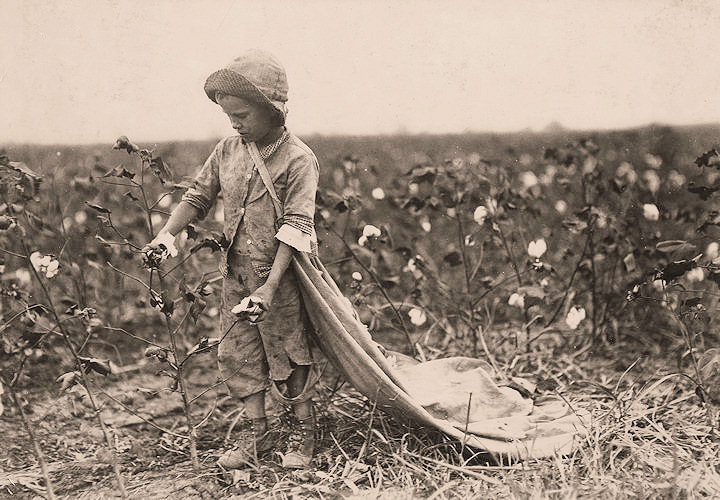
Caption: A child working in a cotton field in the early 20th century. Even as factories grew, agriculture remained one of the most common forms of child labor.
Image credit: Lewis W. Hine / public domain
This image reminds us of something often forgotten:
child labor was not just industrial—it was everywhere.
The Rise of Industrial Exploitation
What made factory labor different was not just the work itself but the system behind it.
In factories:
- Work was centralized and continuous
- Machines dictated speed and rhythm
- Children were hired as labor units, not family members
“Children… worked the same 12-hour shifts that adults did.” [worldhistory.org]
Unlike farm work, factory labor separated children from family oversight and placed them under strict control.
Long Hours, Dangerous Work
Factory and mine conditions were often brutal:
- Workdays could last 12 to 16 hours
- Children as young as five were employed
- Injuries, illness, and exhaustion were common
[worldhistory.org], [ducksters.com]
In textile mills, children worked among fast-moving machines.
In mines, they crawled through narrow tunnels carrying heavy loads.
The risks were constant and often life-altering. A Workforce Built on Children
Child labor was not rare it was central.
During the 19th century:
- Children worked across multiple industries
- Many were still in agriculture—but increasing numbers moved into factories
- Millions contributed to economic growth
Industrial expansion was powered not just by machines—but by young workers.
The Industrial Revolution did more than change where children's work changed how they were perceived.
Children were no longer primarily:
- family helpers
- apprentices
They became:
- wage laborers
- industrial workers
And for the first time, society began to question whether this transformation had gone too far.
Closing Thought:
Child labor did not begin with factories. It began in fields, homes, and families where work was part of survival. But the Industrial Revolution transformed that reality. What had once been shared with labor within a household became something far harsher: a system of exploitation driven by profit, where children became essential but expendable workers.
Part 3: A Day in the Life of a Working Child
Series: Child Labor Through the Ages: From Survival to Reform
Before Dawn
“I was most generally awaking… sometimes asleep… by my parents.”
You do not wake up—you are lifted.
Your body is still heavy with sleep, but the day has already begun. It is still dark outside. The cold creeps through the thin fabric of your clothes as you are shaken, pulled from bed, pushed toward the door.
It is not yet morning. But it is time to work.
“I go at four in the morning…” [dobelsteinlaw.com]
You’re eight years old.
Entering the Mill
The factory looms in the distance long before the sun rises—a massive structure of brick and smoke. Inside, the air is thick with dust and heat.
The machines are already running.
The noise was overwhelming at first. Hundreds of spinning frames, clattering gears, and whirring belts. The sound doesn’t stop—it never stops.
“Children worked long hours in dangerous, often fatal conditions… often the same hours as adults.” [labordoc.ilo.org]
You take your place, not beside your parents, but among the machines.
Morning Work: Speed and Fear
Your job is simple, they say.
You clean the machines. You fix broken threads. You move quickly—always quickly.
Your hands are small enough to reach into the moving parts. That is why you were hired.
Children were valued because they could “fit into tight spaces” and handle machinery adults could not. [unicefusa.org]
But the machines do not stop for you.
If you are too slow, the threads break. If you are careless, your fingers are caught.
You have seen it happen before.
Time Without Measure
There are no clocks in your world—only the rhythm of the machines.
Hours pass, but you do not leave.
- No breakfast break
- No school
- No rest
Only work.
Children often worked 12 to 16 hours a day in factories and mines. [timetoast.com]
You grow tired. Your legs ache. The noise fills your head until it becomes part of you. Still, you keep going.
The Midday Collapse
At some point—perhaps midday, perhaps later—you feel it.
Your hands are slow. Your head dips.
Just for a moment.
That is when it happens.
“If I had been too late, I was most commonly beaten.” [everycrsreport.com]
The overseer notices everything.
A shout. A strike. A sharp reminder that you are not here to rest.
Fear wakes you faster than sleep ever could.
Evening Without End
The light outside begins to fade. Inside, nothing changes.
The machines continue. You continue.
“From five in the morning till nine at night.” [everycrsreport.com]
You no longer feel your fingers. The air is harder to breathe. The dust clings to your skin, your lungs, your thoughts.
Children beside you cough. Some limps. Some simply stare ahead, moving without thinking.
There is no energy left for anything else.
The Walk Home
When the machines finally stop, it will be dark again.
The day has come full circle.
You walk home slowly, carrying the weight of hours you cannot count. There is nothing left—no time to play, no time to learn.
Only sleep and tomorrow will be the same.
Historical Reflection: Childhood Lost
This diary-style experience is not imagined - it is built from real testimony.
Investigations like the 1832 Sadler Report revealed children:
- Starting work as young as six
- Working up to 14–16 hours per day
- Enduring punishment, exhaustion, and injury
[stopchildlabor.org], [everycrsreport.com]
For many, education was replaced entirely by labor. Childhood, as we understand it today, simply did not exist.
What This Reveals
This “day” tells us three critical truths:
- Time Was Controlled by Machines
Children’s lives were dictated not by natural rhythms—but by industrial production.
- Work Replaced Development
Schooling, play, and rest were sacrificed for economic survival.
- Fear Enforced Efficiency
Punishment and exhaustion ensure productivity in a system with little regulation.
Closing Thought
For millions of children, this was not a single day it was every day. The Industrial Revolution didn’t just put children to work. It reshaped their lives around labor, reducing childhood to endurance. But a change was coming. In Part 4, we’ll explore how reformers, activists, and ordinary citizens began to push back—and how outrage slowly turned into action.
Next in the series:
Part 4 — “Outrage and Reform: The Fight to End Child Labor”
Add comment
Comments